Shop Drawings
What Are the Standard Marble Edge Profiles Used in UAE Projects?
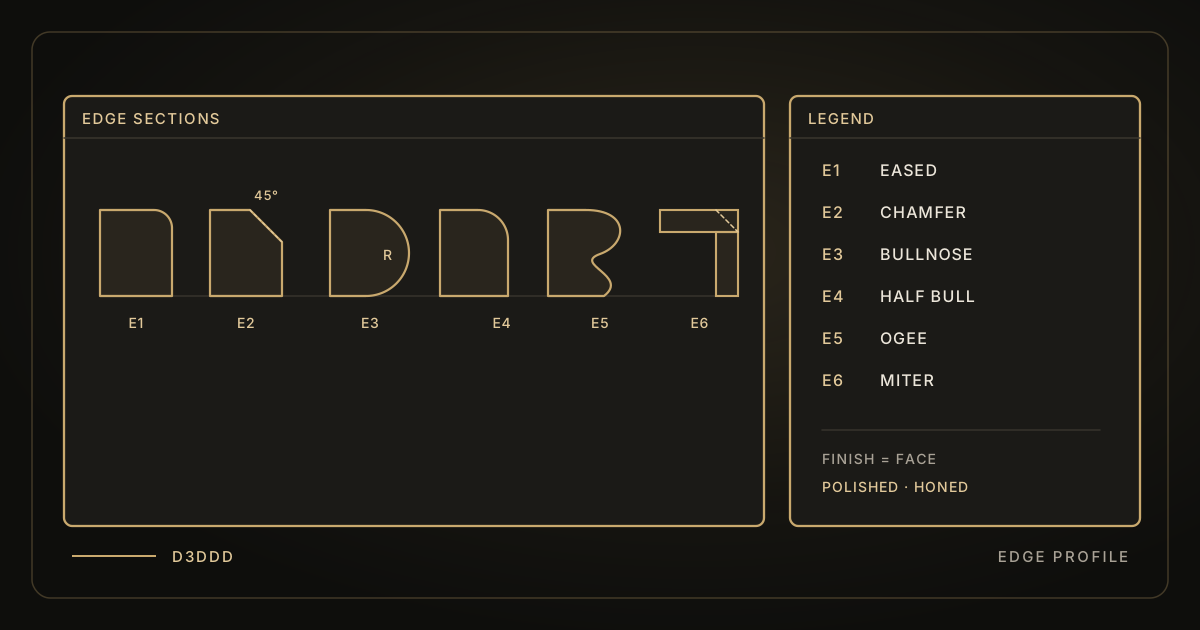
The most common marble edge profiles are the eased (pencil) edge, chamfer, bullnose, half bullnose, ogee and the mitered (waterfall) edge. Each one changes how a countertop, vanity, step or threshold looks and feels, and each must be called out on the drawing so the workshop cuts it correctly.
What are the common marble edge profiles?
- Eased or pencil edge: a square edge with the sharp corner lightly softened. Clean and modern, and the most common for vanities and cladding.
- Chamfer: the corner is cut at an angle, usually 45 degrees. Often used on steps, window sills and thresholds.
- Full bullnose: the whole edge is rounded into a half circle. Soft to touch, common on countertops and stair treads.
- Half bullnose: only the top corner is rounded and the lower edge stays square.
- Ogee: an S-shaped curve, typical of classic and traditional interiors.
- Mitered edge: two pieces are cut at an angle and joined so the stone looks thicker or wraps a corner without a visible edge.
Which edge suits which element?
- Vanity tops and countertops: eased, bullnose or mitered edges are popular. Pick based on the look and how much wear the edge will get.
- Stair treads: a chamfer or bullnose avoids sharp nosings.
- Thresholds and sills: chamfer or eased edges are common.
- Feature or classic pieces: ogee and other decorative profiles.
How should edges be shown on drawings?
- Give each edge profile a named code, such as E1, E2, E3, and list them in a legend.
- Draw a small section detail of each profile with its dimensions, such as radius or chamfer size.
- Mark on the plan or elevation which edges of each numbered piece take which profile.
- State the finish of the edge, polished or honed, and note it should match the face.
- Note any edge that is hidden, glued or mitered, so it is not worked unnecessarily.
Common mistakes
- Writing only “bullnose” with no radius.
- Forgetting that thin stone may not allow a deep profile.
- Not marking which edges of a piece are exposed.
- Leaving the edge finish out of the drawing legend.
Frequently Asked Questions
Which marble edge is the most common?
The eased edge and the bullnose are very common on countertops and vanities. The right choice depends on the design.
Do edge profiles change the price?
They can, because more complex profiles take more workshop time. Ask your fabricator for their pricing.
Should the edge profile be on the shop drawing or the fabrication drawing?
Both benefit from it. The shop drawing shows the design intent for approval, and the fabrication drawing gives the exact size and code for cutting.
How much do marble drawings cost?
A D3DDD shop drawing pack is AED 1,200, with 50% paid upfront. Larger scopes are quoted individually.
Get your edge details drawn by D3DDD
D3DDD (Dubai 3D Design & Draft) prepares marble and stone shop drawings with edge legends, section details and cutting lists for contractors, fabricators, designers and homeowners across the UAE. See the Marble Shop Drawings service page, and read our related posts on marble shop drawings vs fabrication drawings, slab allocation and cutting optimization, and the UAE marble shop drawings checklist.