Estimation
What Is a Quantity Takeoff in Construction?
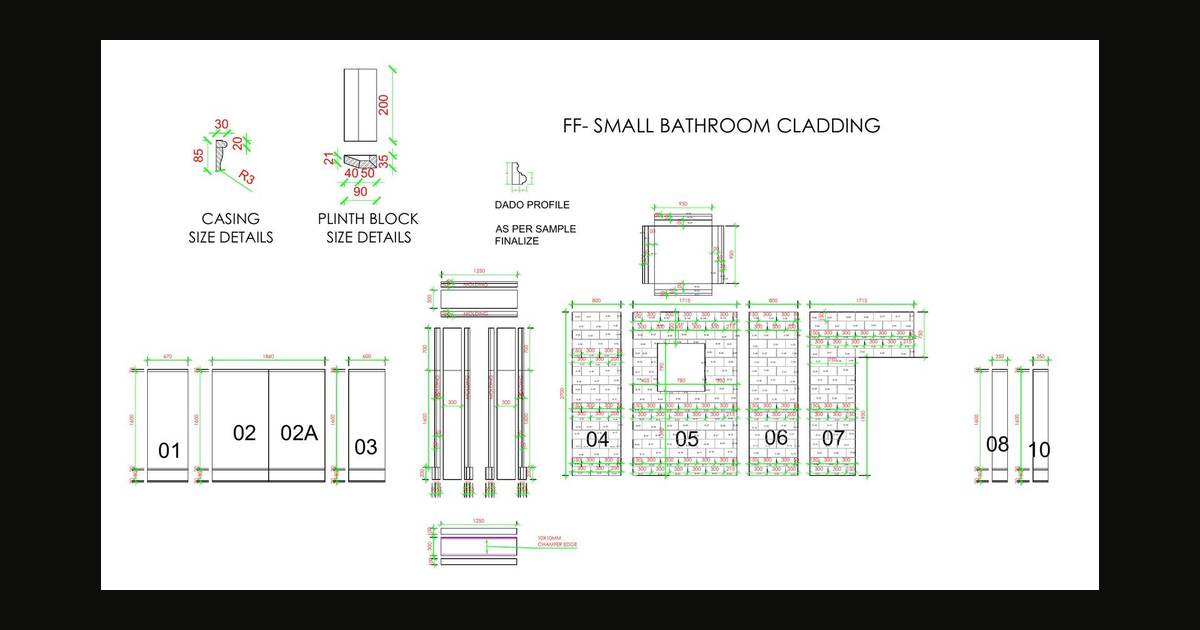
Portfolio sheet: bathroom slab cutting layout, D3DDD.
A quantity take-off is the measurement of a project from its drawings: areas, linear metres and counts, each tied back to the sheet it came from. It is not, by itself, a priced bid, and it is not the same document as a bill of quantities (BOQ), though the two are often prepared together. On fit-out and construction work in Dubai and across the UAE, a take-off is what a contractor uses to price, order or check that an approved revision has not changed the quantities they already sent out.
This article explains what a take-off contains, how it differs from a BOQ, and how D3DDD prepares one. The service page is architectural estimation. For the stone-only method — waste allowances, cutting lists and slab areas — use the already-live guide How to calculate marble quantities and reduce waste. This post is the wider construction explanation, not a second marble-quantity article.
What a quantity take-off is
A take-off starts from the drawings you actually have: plans, elevations, sections and schedules. Each line in the take-off names the sheet it came from and the unit being measured. Typical units, as already described on the estimation service page, include square metres of flooring or finishes, linear metres of skirting, and counts of items such as sink cut-outs.
Two rules make a take-off usable by someone who did not produce it:
- A quantity that cannot be seen on a drawing is marked as an assumption, not hidden inside a total.
- Assumptions that affect many lines — joint width, or cutting waste on stone — sit in the header of the schedule, not buried in a cell, so the person pricing the work can change them.
If those two rules are skipped, a later revision or a different wastage allowance can quietly make the order wrong, and no one can see why.
D3DDD’s take-offs are issued as spreadsheet files, plus PDF when you need a frozen copy for a tender. Piece or finish IDs are matched to the drawings so procurement and fabrication are talking about the same items. New DWG sheets are included only when drawings are part of the same quote. A numbers-only package does not invent a drawing set.
How a take-off differs from a BOQ
The two terms are often used as if they were interchangeable. They are not.
A quantity take-off is the measurement itself: the working-out. It is the list of areas, lengths and counts, with sources and assumptions.
A bill of quantities (BOQ) is the structured document those measurements are organised into, so a revision of the drawings can be compared with the previous issue and a contractor or supplier can price or order from it. On the estimation service this is already a listed deliverable: a BOQ organised so a later issue of the drawings can be compared with the earlier one.
You can have a take-off without issuing a formal bill, and you can have a bill that is little more than a re-typed take-off. In practice, UAE contractors often need both: the take-off as the checkable working, and the BOQ as the document that travels with a tender or an order. A longer explanation of how a BOQ sits next to an estimate and a quotation is a separate topic; the short version is that a take-off and a BOQ are measured documents, while a quotation is a priced offer.
D3DDD does not claim a single mandatory UAE bill format or a tender-law rule. If the client already has an empty template, send it with the drawings and the schedules follow that column order.
What can be measured
Whatever is visible on the drawings in the scope can be measured. The live service already lists:
- Stone quantities — areas, linear metres and piece counts, with the cutting-waste assumption written in the header
- Joinery, flooring, wall finishes and ceiling areas, when those drawings exist
- Material schedules for stone, joinery or finishes, ready to send to a supplier
- Revision-aware updates when the design or a site size changes
When a villa has both a stone package and a joinery package, the two schedules stay separate so a stone yard is not asked to price cabinet carcasses. That split is already on the service page, and it is worth repeating in the enquiry: say which trades you want measured.
Stone quantities can sit inside a marble shop drawings package or be measured from drawings you already have. The practical side of a stone cutting list is also described in slab nesting and cutting lists. A measured bathroom example in the portfolio is the Venatino slab cutting layout, where numbered panels are nested on real slab photos. This article does not repeat that stone method; it only points to it.
If you also need the sheets to be drawn, not only measured, that work is architectural drafting or, for interiors, fit-out and joinery shop drawings.
How UAE contractors typically use a take-off
On projects in Dubai, Abu Dhabi and Sharjah the bill is often attached to the same submission as the shop drawings. The consultant comments on the drawings; the contractor uses the bill to price or to order. When a comment changes a height or a stone thickness, the quantities have to move with the revision or the order will not match the approved sheet. That sequence is already described on the estimation page. It is a description of how the documents travel, not a claim about a particular tender law.
A take-off is also useful before anyone tenders: as a check that a design option is even orderable, or as the basis for an early cost plan to compare finishes. Early cost framing to compare options before tender is a listed sub-service on the same page. It is still based on measurements from drawings, with assumptions written down.
If the design is still only a concept sketch, the figures will be rougher, and they should be labelled that way. A take-off from an approved, dimensioned set is a different job from a first pass on a presentation plan.
What to send, and how the work is quoted
Estimation at D3DDD is quoted per package. There is no published rate per page or per square metre. The AED figures published elsewhere on the site for website packages, and the owner-approved pack prices for a marble shop-drawing pack and a single 3D render, are not estimation rates.
The delivery date is confirmed in writing with the price, before work starts. An updated issue, when the design or the site size changes, is quoted as its own step if the change is large, so the bill stays tied to the approved revision.
To ask for a quote, send:
- The current drawings (PDF is enough for a numbers-only package; DWG helps)
- The trades you want measured
- Any empty bill template your client already uses
- The emirate and whether the set is a first issue or a revision
Use the contact form.
Frequently Asked Questions
What is a quantity take-off, in one sentence?
It is the measurement of areas, lengths and counts from the project drawings, with each figure tied to a sheet and with assumptions written down.
Is a take-off the same as a BOQ?
No. The take-off is the measurement. The BOQ is the structured bill those measurements are organised into. D3DDD can prepare both.
Can you take off from PDFs only?
Yes, when the figures can be read from the PDF set. New DWG sheets are included only when drawings are part of the same quote.
Do you have a published price per square metre?
No. Estimation is quoted per package. Scope, fee and delivery date are confirmed in writing before work starts.
Request a quote
If you have a drawing set that needs a quantity take-off or a BOQ for a project in Dubai or elsewhere in the UAE, send the files and say which trades to measure.